
CLICK ON THIS LINK :
https://www.instagram.com/reel/Df1fkOyyEWm/?rpxt=MTV3d3NhMmRzcWkyYw==
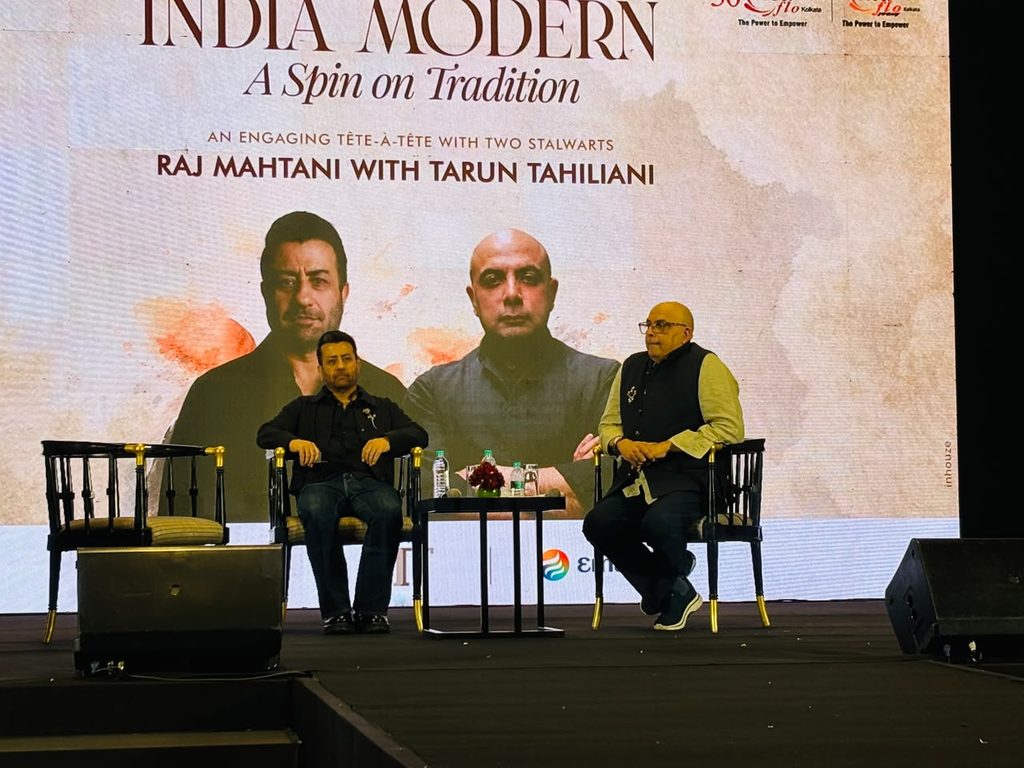
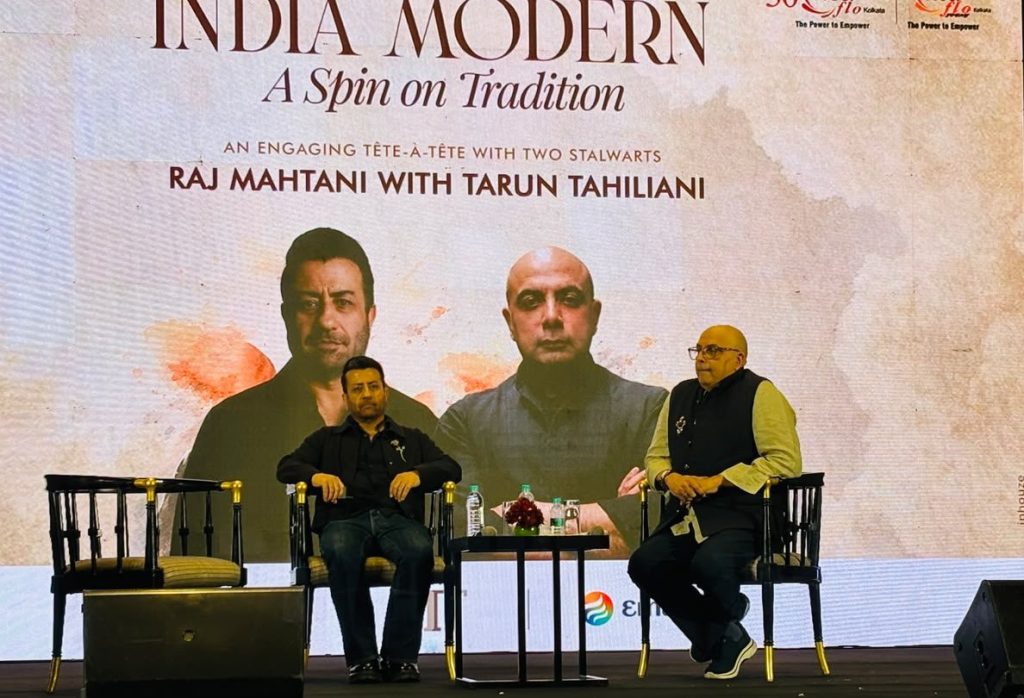
KOLKATA, 16 November 2026: In a compelling celebration of Indian design, craftsmanship and contemporary style, FICCI FLO Kolkata and YFLO Kolkata jointly presented ‘India Modern – A Spin on Tradition’, featuring celebrated fashion designer Tarun Tahiliani and renowned jewellery designer Raj Mahtani, at the Ballroom of JW Marriott, Kolkata. The afternoon brought together two distinguished creative voices for an immersive exploration of how India’s rich artistic heritage can be reinterpreted for the modern world. The programme was graced by Ms. Puja Garg, National President, FICCI FLO; Mrs. Mansi Agarwal, Chairperson, FICCI FLO Kolkata; and Mrs. Anisha Juneja, Chairperson, YFLO Kolkata.
Moving beyond a conventional designer interaction, the programme unfolded through an engaging blend of historical references, visual presentations, design narratives and live styling demonstrations. Through carefully curated imagery and a showcase of ensembles and jewellery, the designers took the audience on a journey across centuries of Indian and international design influences, illustrating how traditional forms, motifs, textiles and craftsmanship continue to inform contemporary creative expression. The presentation offered an opportunity to understand not only the finished creations, but also the research, interpretation and design thinking that shape them.
Tarun Tahiliani traced the evolution of Indian fashion through historical paintings, archival references and images that documented the way people dressed across different periods. He drew attention to the extraordinary diversity of India’s sartorial identity, shaped by regional traditions, cultural exchanges, historical influences and the country’s varied textile vocabulary. His presentation demonstrated how drapes, silhouettes, brocades, embroidery, surface treatments and traditional forms can be revisited and transformed into modern clothing without losing their cultural character.
A particularly significant aspect of his presentation was the relationship between historical documentation and contemporary design. Using visual references as a starting point, he explained how a garment’s form, construction and fall could be studied, reinterpreted and adapted to the individual. He also reflected on the changing expectations of women and the need for clothing to respond to modern lifestyles. Comfort, movement, proportion and wearability, he emphasised, are as integral to good design as visual appeal. His larger message was that Indian design need not imitate international trends to establish its relevance; it possesses an extensive and distinctive vocabulary of its own.
Tarun Tahiliani said, “India has an extraordinary design vocabulary, shaped by its history, textiles, regional influences and craftsmanship. The challenge and opportunity lie in interpreting these references for the present while retaining their essence. Good design must also allow a person to feel comfortable, confident and entirely themselves.”
Raj Mahtani complemented this exploration with an extensive visual journey through approximately 5,000 years of documented jewellery history. Taking the audience across ancient Egyptian and Roman traditions, the Byzantine, Renaissance, Georgian and Victorian periods, Art Nouveau and Art Deco, as well as the Mughal and princely eras of India, he demonstrated how motifs, gemstones, settings and techniques have travelled across generations and cultures. He highlighted how many design elements that appear contemporary today have their origins in historical forms, reaffirming that jewellery design is an evolving conversation with the past.
Drawing from this historical perspective, Raj Mahtani illustrated how traditional jewellery can be styled in fresh and individual ways. Through examples of contemporary ensembles and carefully composed looks, he explored the relationship between jewellery, clothing, colour and proportion. The presentation challenged the notion that jewellery must always be worn in conventional combinations, showing how a statement necklace, a brooch, a pair of earrings or an heirloom piece can be styled independently to create a distinctive look. He also underlined the importance of choosing pieces for personal enjoyment rather than external approval, and of balancing ornamentation with the wearer’s own personality.
Raj Mahtani said, “Jewellery carries stories across generations, but how we wear it is a personal choice. There are no fixed rules for styling. The most important thing is to choose what you love, wear it with confidence and allow your own personality to come through.”
The collaboration between the two designers was particularly meaningful, reflecting a creative association that spans several decades. Recalling their earlier work together, Raj Mahtani spoke of how an idea to incorporate jewellery into clothing had evolved into an innovative design expression, illustrating the possibilities that emerge when disciplines intersect. Their shared presentation demonstrated that fashion and jewellery are not isolated forms of adornment, but complementary expressions of identity, craftsmanship and creativity.
The session was further brought to life through a styling-led showcase featuring models, with the designers demonstrating how ensembles and jewellery could be brought together for different occasions and contemporary lifestyles. The practical demonstrations offered the audience valuable insights into accessorising, layering, proportion, the use of heirloom pieces and the art of creating a balanced look. The discussion also addressed the pressures surrounding occasion and wedding dressing, encouraging women to move away from prescriptive styling and make choices that reflect their individuality. An interactive exchange with the audience added another dimension to the programme, with questions touching upon personal style, changing generational preferences, contemporary fashion choices and the evolving expectations of consumers.
The larger significance of the event extended beyond fashion and aesthetics. By bringing the conversation back to India’s traditional textiles, jewellery, craftsmanship and design heritage, the programme reinforced the importance of preserving these creative traditions while enabling them to evolve. It also highlighted the potential of design as a bridge between cultural preservation, contemporary markets and economic opportunity—an especially relevant perspective for an organisation committed to women’s entrepreneurship and economic empowerment.
Ms. Puja Garg, National President, FICCI FLO, said, “Our traditional crafts and textiles embody generations of knowledge and artistic excellence. We must create stronger platforms that connect artisans and women-led enterprises with design, institutions and markets, enabling heritage to translate into sustainable economic opportunity.”
Mrs. Mansi Agarwal, Chairperson, FICCI FLO Kolkata, said, “The idea behind ‘India Modern – A Spin on Tradition’ was to create a meaningful dialogue between our rich heritage and contemporary expression. Tarun Tahiliani and Raj Mahtani brought remarkable depth to this conversation, demonstrating how tradition can be reinterpreted with creativity, confidence and individuality.”
Mrs. Anisha Juneja, Chairperson, YFLO Kolkata, said, “The programme offered an inspiring perspective on how each generation can engage with its cultural inheritance while developing its own identity. It was a valuable opportunity to experience the creative thought and craftsmanship behind contemporary Indian design.”