
Deep Ocean Mission (informally known as Samudrayaan program, (from Sanskrit: Samudra ‘Sea’, Yana ‘Craft, Vehicle’),or currently known as “Samudra Manthan Mission”(Churning of Sea),is an Indian initiative to undertake the deep ocean exploration focused on India’s exclusive economic zones and continental shelf. The program will consist of various crewed and uncrewed submersibles exploring the sea bed. One of the primary aims of the mission is to explore and extract polymetallic nodules, which are composed of minerals like manganese, nickel, cobalt, copper and iron hydroxide. The metals can be used in the manufacturing of electronic devices, smartphones, batteries and solar panels. In 2016, India was allocated a 75,000 km2 (29,000 sq mi) site in the Central Indian Ocean Basin by the International Seabed Authority for the purposes of exploring for and extracting polymetallic nodules on the seabed. The estimated amount of polymetallic nodules in the given area is about 380 million tonnes, containing 4.7 million tonnes of nickel, 4.29 million tonnes of copper and 0.55 million tonnes of cobalt and 92.59 million tonnes of manganese. The approximate cost of the programme will be ₹4077 crore for a of 5-year period and this will be implemented in a phase-wise process. The first phase of the project is from 2021 to 2024. Under its sub-project informally dubbed Samudrayaan, India has aims to send three people into deep sea up to a depth of 6 km (3.7 mi) in Indian Ocean in an indigenous deep sea submersible having an endurance of 72 hours.
Addressing the Indo-Pacific Regional Dialogue 2026 on 4 November 2026, Dr Jitendra Singh said India is progressing towards its first human deep-sea mission to a depth of up to 6,000 metres by 2028 under the Samudrayaan Mission.
India will send its first crewed deep-sea mission to a depth of as much as 6,000 metres by 2028, Union Minister of State (Independent Charge) for Science and Technology and Earth Sciences Dr. Jitendra Singh said while addressing the Indo-Pacific Regional Dialogue (IPRD) 2026 on 4 November 2026. The dialogue is organised by the National Maritime Foundation under the Ministry of Defence. The Minister said the country is aiming at global competitiveness in ocean research through indigenous capability, international cooperation and global co-creation.
Samudrayaan (Deep Ocean Mission)
Deep Ocean Mission (informally known as Samudrayaan program, (from Sanskrit: Samudra ‘Sea’, Yana ‘Craft, Vehicle’),or currently known as “Samudra Manthan Mission”(Churning of Sea),is an Indian initiative to undertake the deep ocean exploration focused on India’s exclusive economic zones and continental shelf. The program will consist of various crewed and uncrewed submersibles exploring the sea bed. One of the primary aims of the mission is to explore and extract polymetallic nodules, which are composed of minerals like manganese, nickel, cobalt, copper and iron hydroxide. The metals can be used in the manufacturing of electronic devices, smartphones, batteries and solar panels.
In 2016, India was allocated a 75,000 km2 (29,000 sq mi) site in the Central Indian Ocean Basin by the International Seabed Authority for the purposes of exploring for and extracting polymetallic nodules on the seabed. The estimated amount of polymetallic nodules in the given area is about 380 million tonnes, containing 4.7 million tonnes of nickel, 4.29 million tonnes of copper and 0.55 million tonnes of cobalt and 92.59 million tonnes of manganese. The approximate cost of the programme will be ₹4077 crore for a of 5-year period and this will be implemented in a phase-wise process. The first phase of the project is from 2021 to 2024. Under its sub-project informally dubbed Samudrayaan, India has aims to send three people into deep sea up to a depth of 6 km (3.7 mi) in Indian Ocean in an indigenous deep sea submersible having an endurance of 72 hours.
Addressing the Indo-Pacific Regional Dialogue 2026 on 4 November 2026, Dr Jitendra Singh said India is progressing towards its first human deep-sea mission to a depth of up to 6,000 metres by 2028 under the Samudrayaan Mission.
India will send its first crewed deep-sea mission to a depth of as much as 6,000 metres by 2028, Union Minister of State (Independent Charge) for Science and Technology and Earth Sciences Dr. Jitendra Singh said while addressing the Indo-Pacific Regional Dialogue (IPRD) 2026 on 4 November 2026. The dialogue is organised by the National Maritime Foundation under the Ministry of Defence. The Minister said the country is aiming at global competitiveness in ocean research through indigenous capability, international cooperation and global co-creation.
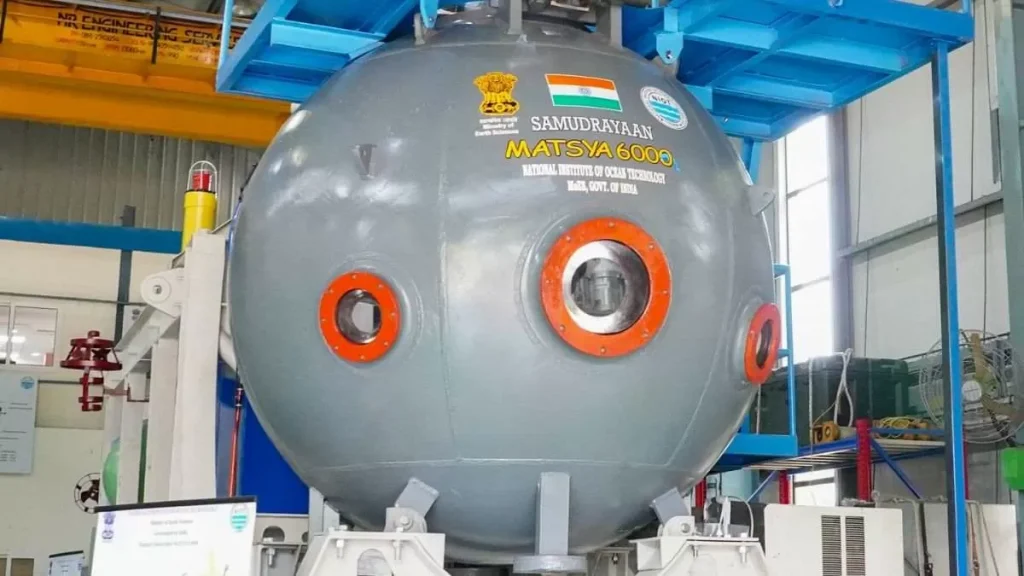
India’s deep-ocean human scientific submersible, MATSYA-6000, completed its unmanned trials at the L&T Shipyard in Kattupalli, Tamil Nadu, on Friday(November 6), marking a vital step forward for the nation’s flagship Samudrayaan Project. The trial was conducted in the presence of Srinivasa Kumar Tummala, Secretary to the Ministry of Earth Sciences (MoES), alongside G. A. Ramadass, Director of the National Institute of Ocean Technology (NIOT). During the exercise, the MoES Secretary systematically assessed the flotation, submerged stability, ballast systems, and various subcomponents of the vehicle. According to the ministry, MATSYA-6000 completed the evaluations strictly in accordance with the prescribed test protocol, clearing the path for its next phase of advanced testing. Designed and indigenously developed by NIOT, MATSYA-6000 is India’s fourth-generation human submersible engineered to carry three crew members inside a compact 2.1-metre diameter spherical hull. Under the aegis of the Samudrayaan Project, the vessel is designed to plunge to depths of up to 6,000 metres, enabling researchers to explore deep-sea mineral resources and marine biodiversity. The submersible features an intricate assembly of indigenous subsystems, including a main ballast system for diving operations, multi-directional thrusters, an onboard battery bank for power supply, and syntactic foam for structural buoyancy. The platform is further equipped with a sophisticated power distribution network, cutting-edge control hardware and software, and advanced underwater navigation instruments. For surface and sub-surface communications, the vehicle relies on an acoustic modem, an underwater telephone, and VHF radio equipment, backed by underwater acoustic positioning systems and surface GPS tracking. Inside the pressure hull, specialised human life-support systems, critical environmental monitoring displays, and navigation joysticks have been integrated. Externally, the vessel carries high-intensity underwater lighting, cameras, and an array of oceanographic sensors.
MATSYA-6000 was originally transported to the Kattupalli facility in 2025 to undergo wet tests and demonstrate operational functionality. Since then, it has undergone a structured series of controlled manned and unmanned trials focusing on power network robustness, vehicle stability, human safety systems, and manoeuvrability, specifically forward and reverse motion. Testing has also rigorously scrutinised navigation and communication systems, alongside scientific payloads featuring multiple oceanographic sensors.